.png)
What Late-Diagnosed ADHD Looks Like In Women
- May 2
- 4 min read
"ADHD is feeling like you're too much and not enough at the same time."
Karise McNamee opened her session at the 2026 Victorian ADHD Conference with that line, and every woman in the room exhaled. She's the founder of Paths With Purpose (counselling for women), and her keynote on late-diagnosed ADHD women was equal parts validating and infuriating — validating for what she named, infuriating for how long it's taken the research to catch up.
If you're a woman/AFAB who has spent years building elaborate systems to appear "on top of things," wondering why everything feels harder for you than it seems to for everyone else, read on. If you love someone who fits that description, read on, too.
What Late-Diagnosed ADHD Looks Like in Women
Karise listed what ADHD in females/AFAB often presents as:
Forgetfulness
Disorganisation
Strict routines and systems to overcompensate (the extensive lists, the elaborate filing systems, the planning that looks like "being organised" but is survival architecture)
Intense shame and self-criticism
Social withdrawal
Emotional overwhelm and sensitivity
Chronic fatigue from masking
Racing, repeating, and intrusive thoughts
Anxiety and constant overwhelm
The quotes from late-diagnosed women in her slides were gutting:
"I just felt like exploding all the time. I hate my kids seeing me like that."
"I work so hard, so people don't see my faults."
"I'm trying so hard, but it's still not good enough!"
"I'm constantly checking I haven't missed anything. It's exhausting."
"What if they made a mistake and I'm really just lazy?"
That last one. The fear that even the diagnosis is wrong, and you really are just the things you've been called your whole life.
Perfectionism as a Coping Mechanism
Karise talked about the perfectionism and striving cycle that so many ADHD women/AFAB get trapped in: striving for perfection, isolation, feeling misunderstood, fear of criticism, overwhelm, sensory overload, masking and perceived faults, and the pendulum swing between extreme achievement and standstill burnout. The overcompensation isn't laziness in disguise, it's a nervous system working overtime to stay afloat in a world that wasn't designed for the way it processes.
Hormones: The Research Gap That Should Make You Angry
This section made my blood boil, in the most informed, evidence-based way possible.
ADHD presents drastically during hormonal changes, which is why more and more women/AFAB are getting late diagnosed during perimenopause. Life stages such as living independently and parenting should be used as contextual evidence in diagnosis, but they often aren't.
The menstrual cycle intensifies ADHD. The first study exploring this relationship was conducted in 2024. Let that sink in.
Oestrogen is often an ally for ADHD. It alters neurotransmitter function. When oestrogen is high, women feel more like themselves.
Progesterone reduces dopamine and serotonin activity. Many ADHD women/AFAB describe the progesterone-dominant phase of their cycle as feeling like their medication isn't working.
ADHD and PMDD: The first study on this was only published in 2021 (WTF). It found 45.5% of ADHD women/AFAB had PMDD. Further research puts the figure at around 46%. PMDD in ADHD, AuDHD, and autistic women/AFAB is extremely common and massively under-researched.
For anyone wanting to explore whether PMDD might be part of their experience, Karise recommended the self-screen at https://iampmd.org/selfscreen.
Perimenopause begins 10–15 years before menopause. Oestrogen levels drop by about 65%, directly affecting dopamine uptake. ADHD challenges increase, and medication and strategies that used to work may stop working. This is often the point where women finally seek diagnosis -not because ADHD is new, but because the scaffolding they've built around it collapses.
What Helps
Karise's practical strategies were grounded and realistic:
Simplify tasks
Support transitions (identify your hardest ones and set timers)
Track your menstrual cycle and plan around it, not against it
Grounding and regulation
Regular sleep (aim for 7–8 hours) as quality sleep supports cognitive function, and ADHD is associated with a delayed circadian rhythm
Non-sleep rest (guided relaxation, yoga nidra) for when sleep isn't available. This is where Karise made the important distinction: "Are you resting, or are you overwhelmed and stuck on the couch?"
Move your body
Above all else: do what works best for YOUR brain and body.
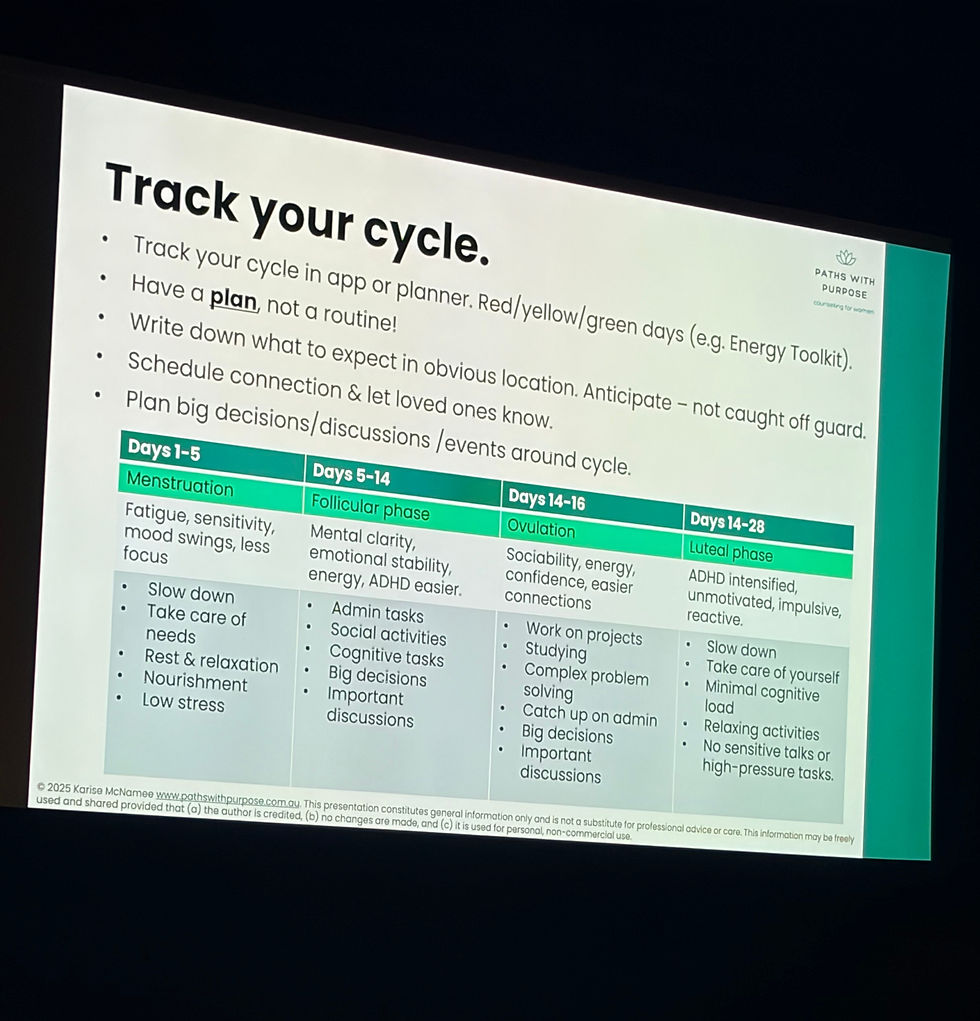
Listen to Your Needs. Meet Your Needs.
Karise's framework for self-care was practical, not performative:
Reduce mental load. Get things out of your head through external processing such as journaling, voice notes, talking to a trusted person.
Check in with yourself: what feels right for me here? Self-compassion means supportive self-actions, not just kind thoughts.
Be your "favourite" self, not your "best" self.
She shared boundary scripts that felt like permission slips that I've already saved to my notes app.
"I need time to think about this. I'll come back to you."
"I can stay for half an hour."
"I can't take on additional responsibilities right now."
"I'm uncomfortable with what you just said."
Her strategies for reducing mental load included mapping your energy patterns and working with them, scheduling downtime, creating buffer time blocks, planning workflow around strengths, and brain-dumping your to-do list into three categories: urgent/now, feel/sleep better, future day.
What I'm Taking From This
I left this session thinking about all the women I know who have spent decades performing "fine" and the cost of that performance on their emotional state, mental health, relationships, and self-worth. The research gap is real, it's harmful, and it's only just starting to close. The fact that we're only now studying how the menstrual cycle impacts ADHD is a failure of the systems designed to help us. But the fact that women like Karise are naming it, teaching it, and building practical tools around what late-diagnosed adhd looks like in women gives me hope.
Be your favourite self. Not your best self.
Karise McNamee is the founder of Paths With Purpose, offering counselling for women. Her resource Paced on Purpose: A Toolkit for ADH(D) and Autistic Energy Management is available through her practice.


Comments