.png)
Why Neurodivergent Kids Can't Always Do What They Did Yesterday (Fluctuating Capacity Explained)
Em Hammond closed the 2026 Victorian ADHD Conference with a session on AuDHD called "NeuroWild Things," and it brought the whole day full circle in a way that felt intentional, even though I don't think it was planned that way.
Em talked about masking, fluctuating capacity, the building blocks kids need to thrive, and why the way we teach is incompatible with so many brains. The thread running through all of it was one idea: we need to stop making space for difference and start expecting it.
Expect Difference
Em made a distinction that reframed everything: When we expect sameness, difference easily feels like a problem. Even if we say it's okay, our actions, assessments, and classrooms tell a different story.
When we expect differences, there is suddenly room for everyone.
Not making space. Not accepting it sometimes. Expecting it.
That shift from tolerance to expectation changes what we build, how we teach, and who gets to belong without having to earn it first.
Masking and What It Costs
Em spoke from personal experience about the costs of masking. When we mask our neurodivergent traits and work hard to perform in a neuronormative way, we're not showing our true selves. Anyone who becomes our friend in that state isn't becoming friends with our true self. Those relationships are superficial. That's not the kind of connection we want our neurodivergent children to find.
Masking was keeping Em from finding authentic, meaningful relationships.
The masking tax shows up across emotional state, mental health, wellbeing, relationships, self-acceptance, and self-worth.
But Em added an important nuance that I really appreciated. Two things can be true at once. Masking can have significant impacts on our long-term mental health and capacity AND masking may be important for maintaining a person's safety in different environments and contexts.
We need to consider the risks of unmasking for this person. Is it safe for them to stand out in this environment? What additional factors, such as racial discrimination, gender discrimination, cultural beliefs, mental and physical health, relational support, and financial stability, are impacting their safety?
This leaves many caregivers deciding whether it's safe for their children to unmask. That's a heavy responsibility, and Em named it without pretending there's a simple answer.
Fluctuating Capacity
Em introduced the fluctuating capacity model using a battery metaphor that was brilliant in its simplicity.
On a good day, the battery is mostly full - small amounts used by fatigue, sensory overload, and emotional overwhelm, with plenty left to handle the unexpected. On a tough day, those same factors take up most of the battery, leaving almost nothing for the unexpected.
Same person. Different day. Wildly different capacity. Both versions of that person have done their best.
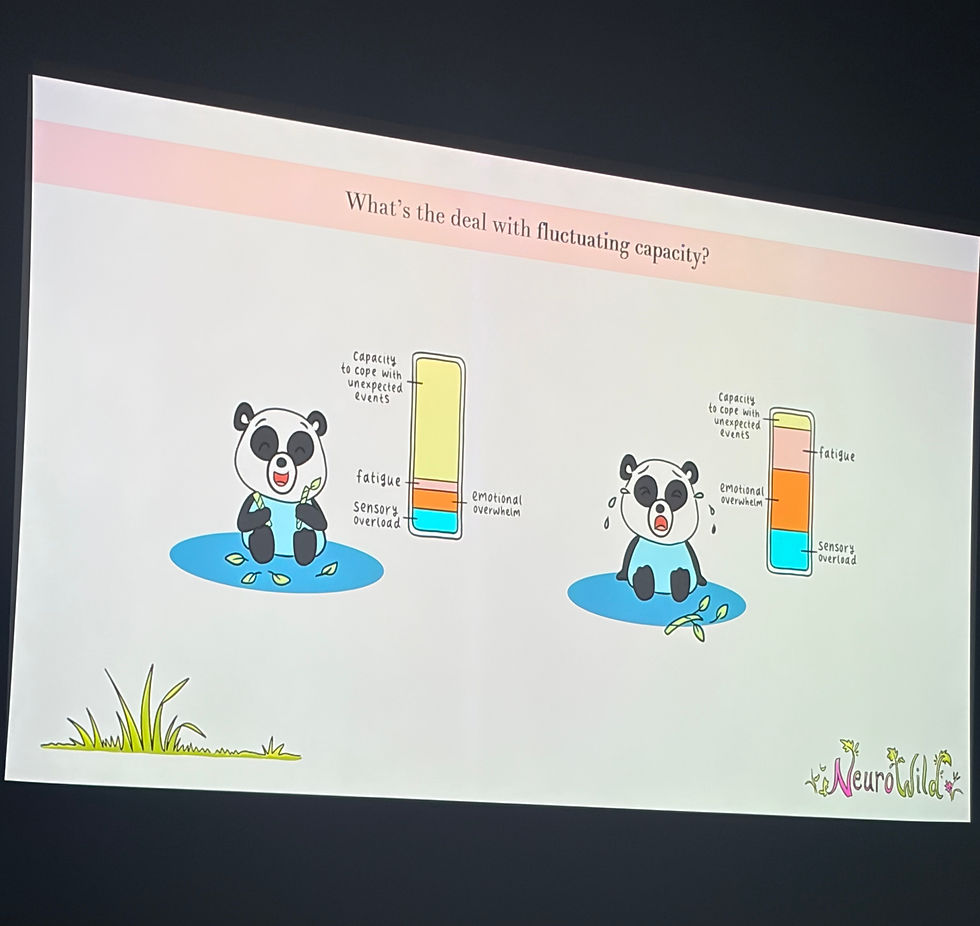
Fluctuating capacity explains why neurodivergent kids are inconsistent, even on the same day. It's not about effort, skills, attitude, or cooperation. We're working with a battery that doesn't charge quickly and drains quickly. Despite this, expectations stay high.
Sometimes the battery isn't enough to do the things we want to do, the things others want us to do, things we were able to do yesterday, handle situations the way we'd like, cope with big feelings, or remember instructions and rules.
Things that drain the battery (and it's usually a combination) include uncomfortable clothes, white noise, being hot, feeling stressed, socialising, too many demands, hunger, ignoring our body's needs, doing too much, discomfort, copying others' mannerisms, sensory input (smells, tastes, textures, lights), competing noise, illness, pain, and feeling unsafe.
We each have different things that drain us and recharge us. Kids can grasp this concept.
The Building Blocks
Em presented a model showing what kids need to thrive, stacked like building blocks:
Foundation (our job as adults): Strengths, Positive Identity, Support Network, Safety & Health. These are the blocks of connection and belonging. If they're missing or shaky, nothing above can balance.
Regulation: Regulated sensory system, co-regulation strategies, regulated emotional system. If the foundation isn't solid, you can't get here.
Executive functioning: Focusing, impulse control, planning, language, learning, memory, flexible thinking, problem solving.
Behaviour: Behaviour, skill development, academics.
Long-term goals: At the very top.

Goals without the blocks below them are set up to fail. It is our job to figure these out for our kids.
When a child is struggling, Em said, check three things: Are the expectations based on sameness rather than difference? Are any of the lower blocks shaky? What's their mental battery at?
Reflect and Invite
Em shared a technique for helping kids talk about their experience: Reflect and Invite.
Reflect: "I'm noticing something [Name what you see without judgment]"
Invite: "I wonder if anyone does that / feels like that." Opening the door without pushing them through it.
The invitation can scale from indirect to direct:
"I wonder what will help me recharge." (Brainstorming strategies)
"I wonder who can help me with these feelings." (Brainstorming safe people)
"I wonder if that happens to anyone else." (Offering space for sharing and validation)
"I wonder if that's ever happened to you?" (Direct invitation)
Children with PDA and RSD need this kind of specific, indirect permission to get talking. You can't demand vulnerability. You can only create the conditions for it.
Let Me Show You
Em made a compelling case for rethinking how we teach. A listening-and-writing task that holds no interest for a child is like pulling teeth. Offer the same task through an outlet of their interest, like art, and suddenly you've got their attention. This is cognitive processing systems at work.
It's "let me SHOW you" (creative learning) rather than "let me TELL you" (quiet, repetitive listening, reading, written answers). The way teaching is expected and measured is incompatible with so many brains.
Full Circle
This was the moment that brought the whole day together. Neurodivergent kids are not "bad learners." But when they're taught in ways that are incompatible with their brains, they start to believe they are. That belief becomes identity. Identity becomes shame.
Right back to Sandhya Menon's opening keynote, six hours earlier. The development of shame. The shift from "I did something wrong" to "I am something wrong."
Em demonstrated this full circle not just in content but in practice, using stories, symbols, imagery, repetition, audience engagement, humour, and movement breaks throughout the presentation. All of which inadvertently supported the different cognitive processing systems of thousands of people in the room. They didn't just talk about expecting differences; they built a presentation that expected it.
What I'm Taking From This
Expect difference. Don't just make room for it. Build for it. Teach for it. Parent for it.
Check the battery. Check the blocks. Check the expectations. It's our job.
Em Hammond's work through NeuroWild Things offers resources to understand and support AuDHD experiences.


Comments