.png)
What I Learned At The 2026 Victorian ADHD Conference And What Every Parent, Teacher, and Human In A Child's Village Needs To Know
I spent today at the 2026 Victorian ADHD Conference in Melbourne, and I need to talk about it.
Not in a polished, "here are my professional takeaways" kind of way. More of a "sat in a dark auditorium for six hours and cried at least four times" kind of way.
There were six speakers, and every single one of them, from different angles, landed on the same truth: the way we understand, support, and show up for neurodivergent people needs to change.
Not in theory. In the actual rooms where it matters, like classrooms, living rooms, and therapy rooms. In the words we choose and the systems we keep building around kids who were never designed to fit inside them.
Here's your recap.
Sandhya Menon on Uncovering the Hidden Shame of ADHD
Sandhya opened with a line that landed hard: "If you've sat with shame yourself, the most powerful thing you can hear is someone say 'yeah, me too.'"
She broke down the difference between guilt and shame. Guilt says, "I made a mistake." Shame says, "I am the mistake."
For ADHDers, that shame often starts early, with school reports that say "if only they applied themselves", and it builds, layer by layer, into something that becomes part of identity rather than something that happened.
Her shame pile-up model was powerful. A trigger leads to a physiological reaction, then a flood of negative feelings, negative self-talk, behavioural reactions, and finally compounding shame — shame about the shame. By the time you're at layer six, you're buried.
Sandhya also said something important: not all shame is toxic. Helpful shame teaches us empathy and acknowledgement. The danger comes when it shifts from being about what we did to who we are.
Her closing hit me the hardest. Our children have words for their experiences that we never had, but having the words isn't enough. It's up to us to help them believe those words, while navigating the fact that nobody taught us this kind of self-kindness either.
Her mantra? "Meh, good enough." She has it displayed in her office. I might need one too.
Dr Siobhan Lamb Talking Beyond the Classroom
Siobhan's session made me feel simultaneously seen and furious, which I think was the point.
She laid out the systemic disconnect that parents of neurodivergent kids know intimately: allied health gives recommendations to schools, teachers look at them and think "what am I supposed to do with this in a class of 30?", and parents burn out trying to connect all the silos while their kids fall through the cracks. Everyone is exhausted. Everyone cares. Nobody is connected.

She shared quotes from parents, teachers, and students. The student's quotes wrecked me.
An 8-year-old said, "When people don't understand you, you start thinking there's something wrong with you." A 14-year-old said, "By the time they gave me the help, I'd already stopped caring."
Her reframes were sharp: what looks like neglect is often paralysis. What looks like hostility is often a desperate attempt to be understood. What looks like disorganisation is often a disability.
She also posed a challenge to the room: "If a neurodivergent student in your school is not thriving. If they are anxious, avoidant, or excluded, do you consider that a failure of the student, or a failure of the system you are responsible for?" There is no neutral answer.
Dr Connie Buckingham on Friendships, Conflicts & Strategies
Connie broke down the four common friendship challenges ADHDers face:
Zoning out mid-conversation
Enthusiastic interrupting (it's not rudeness, it's a pop-up on a computer screen that will disappear if they don't say it now)
Big emotions that aren't matched
Forgetfulness with events and details
Her friendship styles framework was something I wished I'd had as a kid. She named four options: Group, Bouncy Ball (floating between styles), Two Peas in a Pod, and Just Me.
The "Just Me" option was particularly important. For years, she'd get referrals for kids who "didn't want friends," when really those kids needed their free time to recharge from the classroom's overload. It's a legitimate choice, not a problem to fix. I immediately pictured school-age me, playing the piano in the music room at lunchtime, for much-needed reprieve before the second half of the day.
She also introduced the Drama Triangle for understanding conflict, which features the Lion (aggressor), the Mouse (becomes small, loses their voice), and the Magpie (swoops in to fix it). Simple language that gives kids insight into their own patterns.
Karise McNamee, uncovering Late Diagnosed ADHD Women
"ADHD is feeling like you're too much and not enough at the same time."
Karise's session was a mirror held up to every woman in the room who has spent years overcompensating, building elaborate systems to appear "fine," and wondering why everything feels so hard.
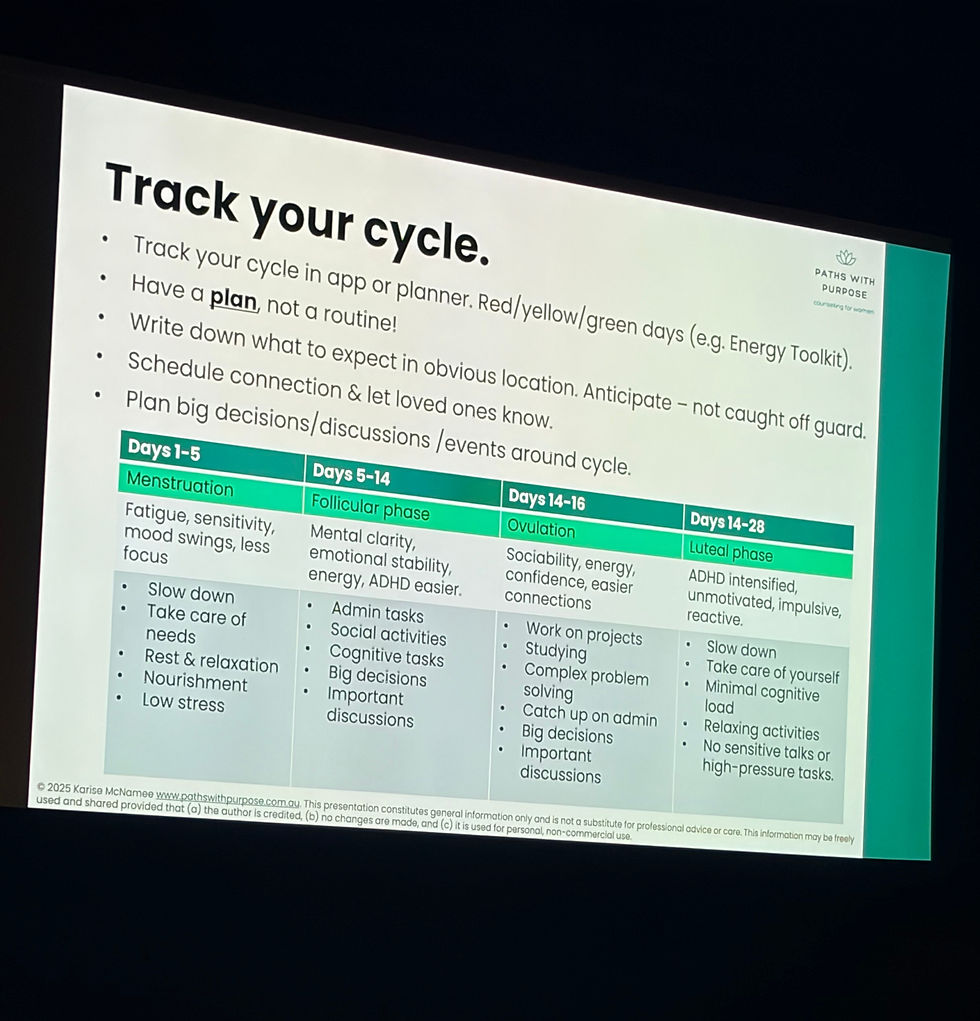
The stats on ADHD and hormones were staggering and infuriating. The first study on the impact of the menstrual cycle on ADHD was conducted in 2024.
Nearly half of ADHD women/AFAB experience PMDD
Oestrogen is an ally for ADHD - when it's high, women/AFAB feel more like themselves
During the progesterone-dominant phase, many describe it as feeling like their medication isn't working
Her cycle-tracking framework was practical and empowering - mapping red, yellow, and green days, planning big decisions and difficult conversations around your cycle rather than being caught off guard.
The boundary scripts she shared were gold. Usable sentences for real situations that I will be immediately adding to my notes app: "I don't have the energy to respond to this right now. I will respond when I feel recharged." "I can't do that, but I can help you find someone who can."
Be your "favourite" self, she said. Not your "best" self.
Vivian Dunstan on The 6 C's of Calm, Connected Parenting
Vivian's tightrope analogy landed immediately. Imagine someone offers you $100 to walk a tightrope, but if you can't do it, you get a consequence. If you don't have the skill, it's lose-lose. That's what we do to neurodivergent kids when we treat brain-based differences as behaviour problems.
Her 6 C's framework, Calm, Curiosity, Compassion, Connection, Collaboration, Consistency, operates as an integrated system, with Curiosity at the core. Curiosity creates a pause. That pause creates calm. Instead of reaction, you get space for compassion.
"Curiosity is what helps you close the gap between the parent you want to be and how you respond when things get hard."
Her Parenting Hierarchy of Needs was a practical tool I'll keep coming back to. Starting from biological stability at the base and working up through regulation, emotional safety, cognitive support, social growth, and purpose, with guiding questions at each level. The goal is to solve the identified problem, not modify behaviour with rewards and consequences.

Em Hammond closing with NeuroWild Things
Em closed the day with a session on AuDHD, bringing everything full circle.
When we expect sameness, difference feels like a problem. When we expect differences, there's room for everyone. Not making space or accepting it sometimes. Expecting it.
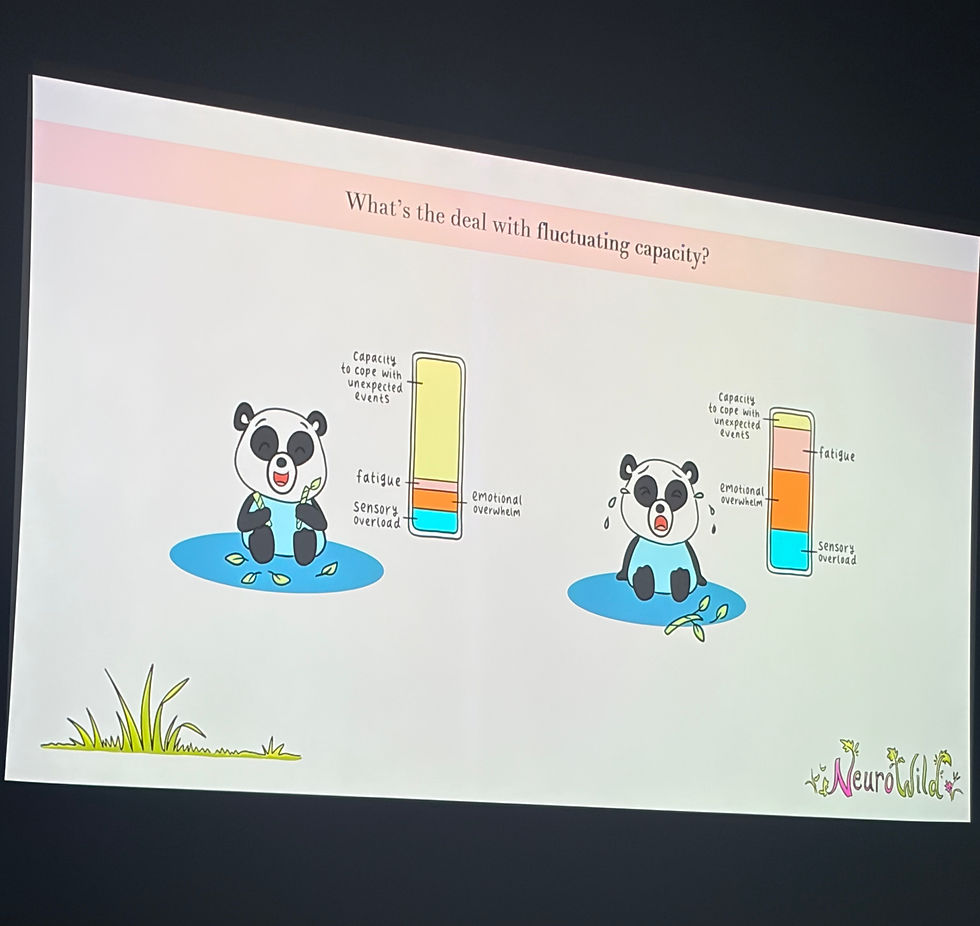
The fluctuating capacity model was brilliant in its simplicity. Same person, different day, wildly different battery level and it's not about effort, attitude, or cooperation. Neurodivergent kids work with a battery that charges and drains quickly, while expectations stay high regardless.
Em's building blocks model showed why goals without foundations fail. You can't get to behaviour, skill development, and long-term goals if the blocks underneath — connection, belonging, regulation, executive functioning — are shaky. When a kid is struggling, check the expectations, check the lower blocks, check the battery.
The moment that brought us full circle: neurodivergent kids are not "bad learners." But when they're taught in ways incompatible with their brains, they start to believe they are. That belief becomes identity. Identity becomes shame. Right back to Sandhya's opening keynote.
The Thread That Ran Through Everything
Every speaker, in their own way, said the same thing: the problem is not the child. The problem is the mismatch between the child and the world we've built around them.
Our job as parents, educators, therapists, and humans in a child's village is to stop asking neurodivergent kids to fit into systems that weren't designed for them, and start designing systems that expect them.
That work starts with us. With our own shame, nervous systems, and willingness to be curious rather than reactive.
It's not about being a perfect parent, educator, therapist or ally. It's about showing up consistently, "meh, good enough", and leaning into the mess and being surprised by who meets us there.


Comments